The EmbedRight Canvas
The two-part canvas for businesses that need AI to change something real, rather than add another subscription.
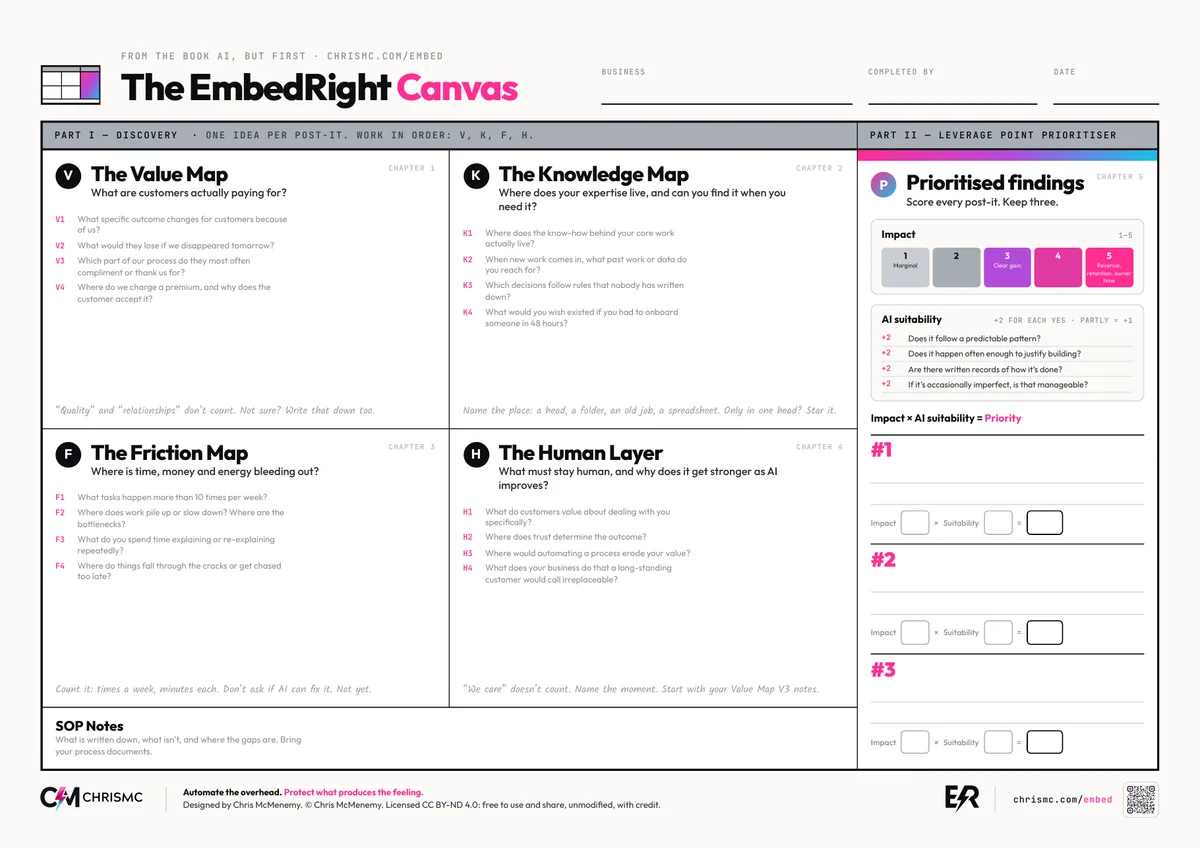
Part one maps the business as it actually works: what customers are genuinely paying for, where the expertise lives and who is holding it, where time and money leak out every week, and what has to stay human. Part two scores every finding on impact against AI suitability and ranks them, so you finish with the three things worth doing first instead of a list of forty you will never start.
Know what your customers actually pay you for before you automate anything.
The usual route starts with a demo. A vendor shows a tool doing something impressive with somebody else's data, and the conversation moves straight to which package and how many seats. That is a procurement decision dressed up as a strategy.
When electric motors first reached factories, many owners bolted them onto layouts built around a steam engine, and the factories performed about as well as before. The gains came when the work itself was redesigned. EmbedRight is that step for AI: four maps of the real job, then a ranked list of what to change.
Section by section, with the questions off the canvas.
The four maps
Work in order: V, K, F, H. One idea per post-it.
- V
The Value Map
What are customers actually paying for?
- V1What specific outcome changes for customers because of us?
- V2What would they lose if we disappeared tomorrow?
- V3Which part of our process do they most often compliment or thank us for?
- V4Where do we charge a premium, and why does the customer accept it?
“Quality” and “relationships” don’t count. Not sure? Write that down too.
- K
The Knowledge Map
Where does your expertise live, and can you find it when you need it?
- K1Where does the know-how behind your core work actually live?
- K2When new work comes in, what past work or data do you reach for?
- K3Which decisions follow rules that nobody has written down?
- K4What would you wish existed if you had to onboard someone in 48 hours?
Name the place: a head, a folder, an old job, a spreadsheet. Only in one head? Star it.
- F
The Friction Map
Where is time, money and energy bleeding out?
- F1What tasks happen more than 10 times per week?
- F2Where does work pile up or slow down? Where are the bottlenecks?
- F3What do you spend time explaining or re-explaining repeatedly?
- F4Where do things fall through the cracks or get chased too late?
Count it: times a week, minutes each. Don’t ask if AI can fix it. Not yet.
- H
The Human Layer
What must stay human, and why does it get stronger as AI improves?
- H1What do customers value about dealing with you specifically?
- H2Where does trust determine the outcome?
- H3Where would automating a process erode your value?
- H4What does your business do that a long-standing customer would call irreplaceable?
“We care” doesn’t count. Name the moment. Start with your Value Map V3 notes.
The companion book.
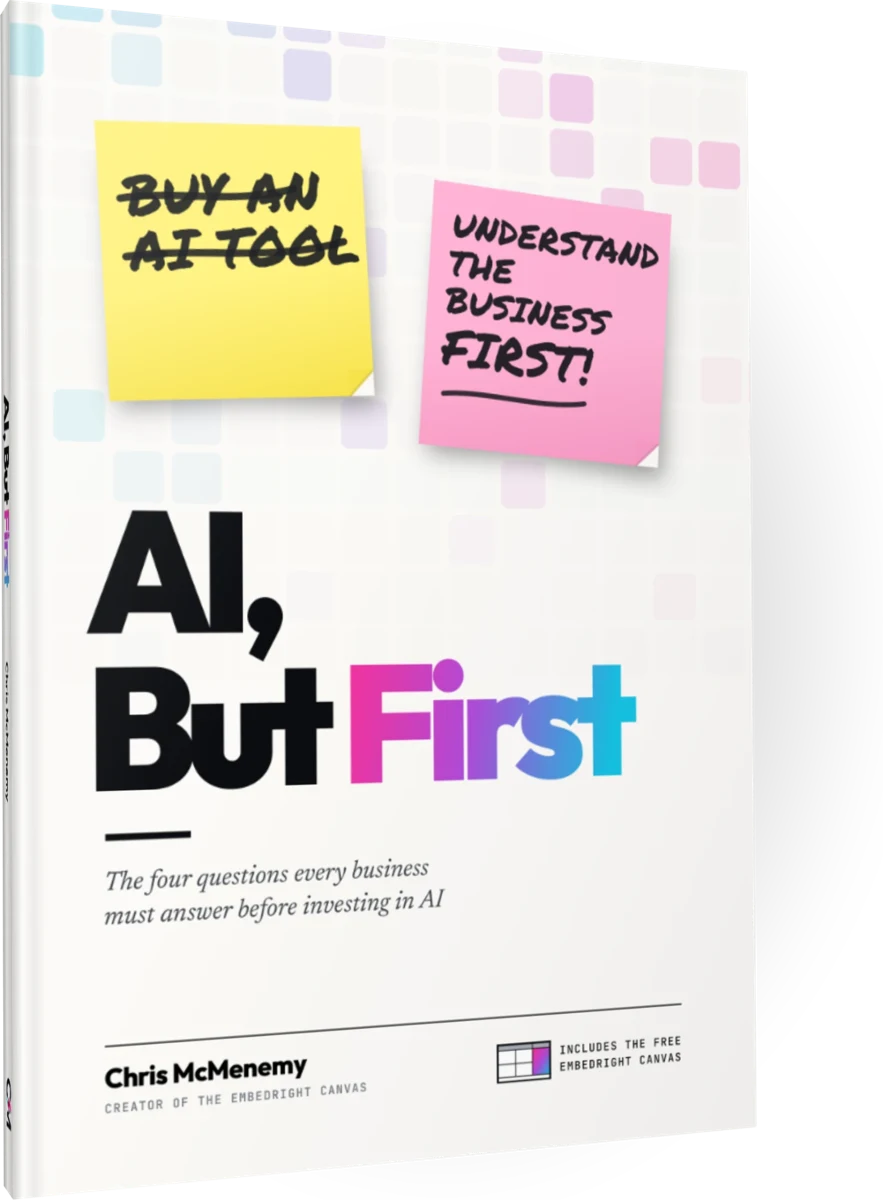
AI, But First
The four questions every business must answer before investing in AI.
Most companies buy the tool and then wonder why nothing changed. This is the part that comes first: working out which bits of a job should survive contact with the software, and which bits were never really the job.
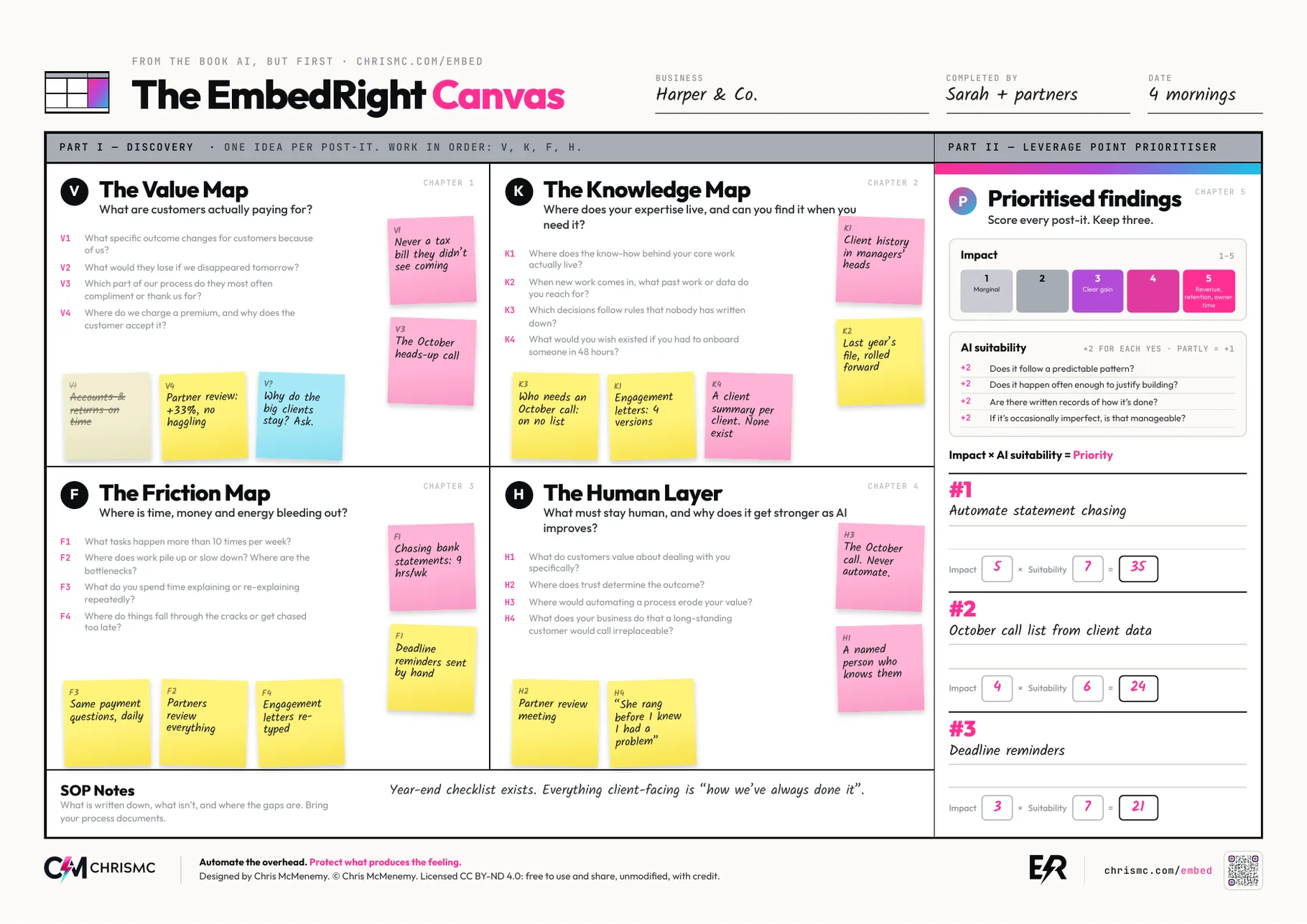
Three, filled in.
The fastest way to see how a canvas is meant to be used is to see one finished.
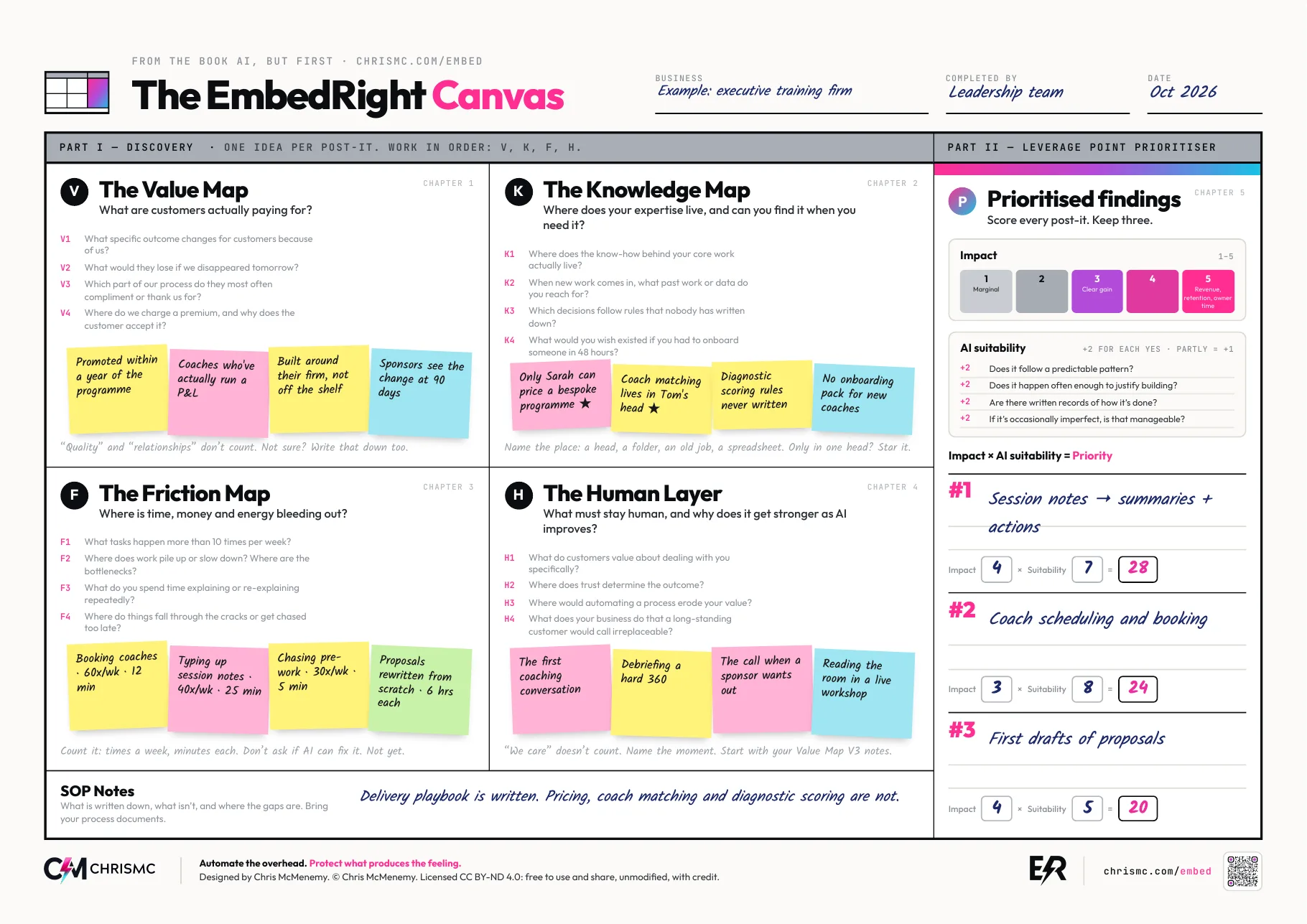
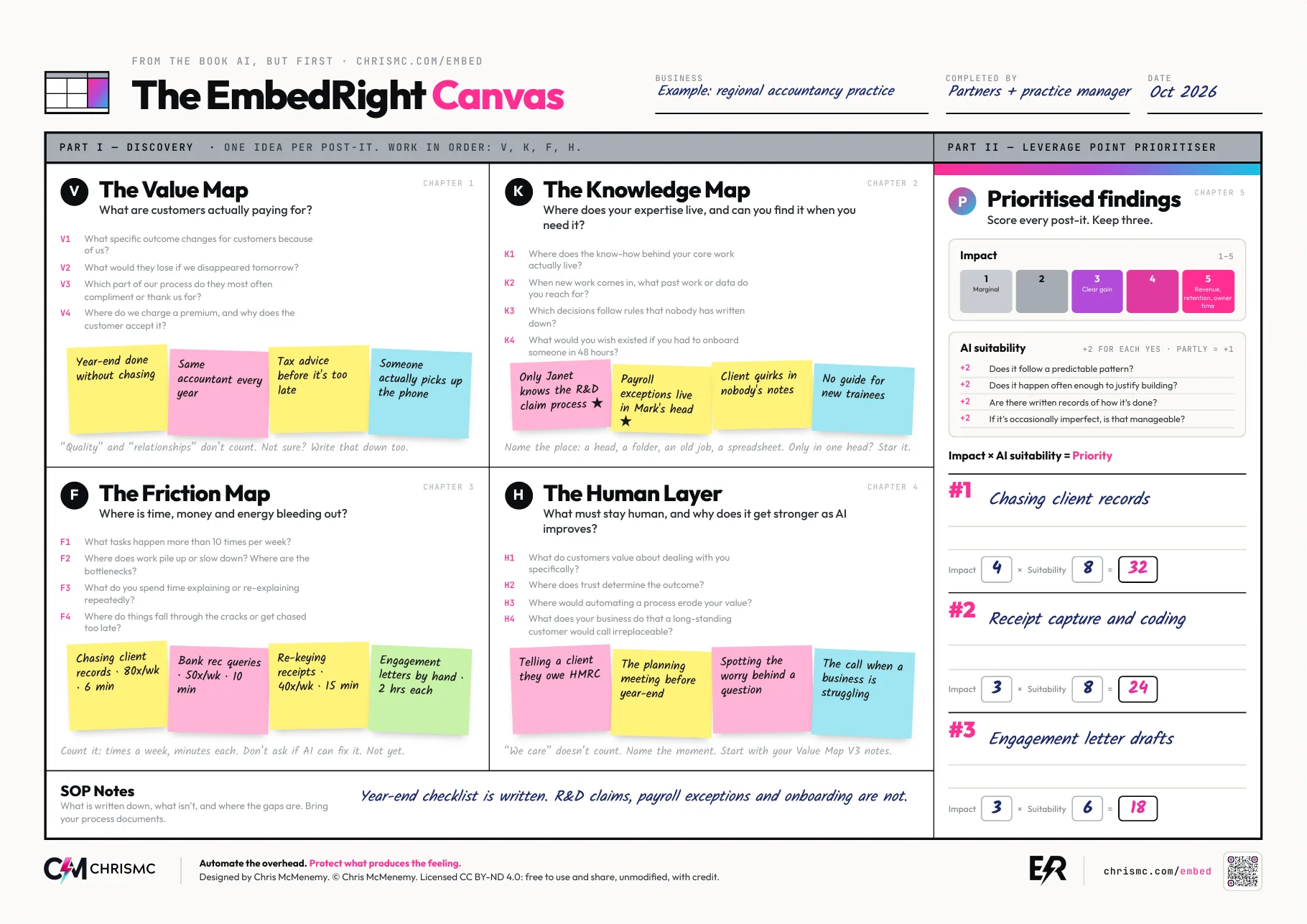
Download the EmbedRight Canvas
The official EmbedRight Canvas, at A3 for a desk and A0 for the wall, with the three worksheets that go with it.
- High-resolution A0 PDF, ready to print and put on a workshop wall
- A3 version for a desk or a smaller team
- Three worksheets: the H3 automation check, the knowledge audit worksheet and the SOP audit worksheet, in A4 and US Letter
- Free to use in your business and to share with your team
Map what customers actually pay for, where the expertise lives, where time leaks out and what has to stay human. Then keep the three things worth doing first.


Let's talk.
Want a canvas run properly on your business? Tell me what you're building and where it's stuck. I'll run the session with the people who actually do the work, then stay for what comes out of it.
Which is closest?

What I'm seeing from inside the machine.
The roles quietly disappearing. The businesses that are suddenly viable. What I built this week and what broke doing it. And what I'd actually do about any of it, rather than what sounds good on LinkedIn.