
The short answer
AI is reliably good at four jobs in a law firm: finding things in large volumes of documents, drafting documents the firm has already written a hundred times, turning unstructured material into structured records, and absorbing the administrative work fee earners should never have been doing. Everything else is a demonstration, not a business case.
The test that separates the four from the rest
Those four jobs have one property in common, and it is the only test worth applying to any legal AI tool you are shown.
A human can check the output faster than they could have produced it.
That is the whole thing. When checking is quicker than doing, AI makes a fee earner faster and the risk stays bounded, because a qualified person still signs it off and the error surfaces before it leaves the building. When checking takes as long as doing, you have bought nothing. And when the output cannot be checked at all without redoing the work from scratch, which is the case for anything that invents citations or quietly omits what it did not find, you have bought a liability and put your name on it.
Run that test over the brochure the next time someone demonstrates a tool to you. Most of what gets pitched to law firms fails it. The four below pass.
1Finding things in volume
Disclosure, due diligence, bundle review, any exercise where the answer is somewhere inside twelve thousand documents and somebody has to go and get it.
This is the strongest case in legal, and it is strong because the job is pattern matching across more material than a person can hold. The model reads everything, flags what matches, and hands back a shortlist. A solicitor reads the shortlist. The checking is genuinely faster than the doing, by a wide margin, because reading two hundred flagged passages is not the same job as reading twelve thousand documents.
The constraint is that recall is never perfect and you must assume it is not. The tool is a first pass that narrows the field, not a guarantee that nothing was missed. Firms that treat it as the latter are the ones that get hurt. Scope it as triage, keep the human review on the shortlist, and sample what was rejected.
Worth knowing: this is also the category where the tooling is most mature and most expensive. You are often buying something your document management vendor already sells as a module.
2Drafting what you have drafted a hundred times
Standard-form contracts. Leases. Letters of claim. Engagement letters. Section 21 notices. The documents where the structure is settled, the variations are known, and the firm has produced hundreds of near-identical versions already.
The value here is almost entirely in your own precedent bank, not in the model's general knowledge of law. A model drafting from first principles produces something that reads like a contract and is not one. A model drafting from your firm's precedents, with your clauses and your house positions, produces a first draft a fee earner can correct in ten minutes.
That distinction decides whether this works. If a tool cannot be pointed at your own precedents, it is doing the wrong version of this job.
The constraint is that it is useless for novel drafting, and novel drafting is where your margin is. This job takes the routine end of the work off the desk so the people who can do the other kind have time to do it. It does not do the other kind.
3Turning unstructured material into structured records
This is the one nobody pitches and it is quietly the biggest time sink in a working practice.
Attendance notes into matter records. Email threads into a chronology. A scanned bundle into something searchable. A client's shoebox of correspondence into a dated index. Voice notes from a hearing into a file note.
Nobody sells this as artificial intelligence because it does not demonstrate well. It is also the work that fee earners complain about most, that gets done badly at seven in the evening, and that costs the firm real money in write-offs when it is not done at all.
The checking test passes comfortably. Reading a generated chronology against the source emails is far quicker than building one. And the failure mode is benign: a wrong date in a chronology gets caught by the person who knows the matter.
If you do one of these four first, do this one. It is the cheapest to implement, it does not touch advice, and it is the one your fee earners will thank you for.
4The work that was never legal work
Time recording. File opening. Conflict check preparation. Client onboarding and the identity documents that go with it. Billing narratives. Chasing the things that need chasing.
None of this requires a law degree and most of it is done by people who have one. It is overhead that attached itself to fee earners because there was nobody else to do it and no system that could.
This is the least glamorous of the four and probably the highest return, because you are not making legal work faster, you are removing non-legal work from expensive people. The business case does not depend on the model being clever. It depends on it being adequate and cheap, which it now is.
The four it is bad at, and why
Worth being equally plain about the other side, because the firms that get burned are the ones who were told there was no other side.
Legal research it cannot show its working for. The failure mode here is not that the model is wrong occasionally. It is that it is wrong in a way that looks exactly like being right. A fabricated citation is formatted identically to a real one. This is not hypothetical: in Mata v. Avianca in 2023, lawyers in New York were sanctioned after filing a brief containing case citations that did not exist, produced by ChatGPT. Research tools that retrieve and link to the actual source are a different proposition from a model answering from memory. Know which one you are buying.
Judgement. Whether to settle. What this client can actually afford to risk. Whether the other side is bluffing. These are not information problems and more information does not solve them.
Anything privileged going into a tool you do not control. Where the data goes, who trains on it, and what the contract says about retention are not IT questions, they are professional obligation questions. Get them answered in writing before anything client-related is typed into anything.
Advice. Obvious, and still worth writing down, because the distance between a well-drafted document and advice is shorter than it looks once a tool is sitting in the workflow and people start leaning on it.
What this looked like in practice
I run the technical side of One Scriptum, which began as document automation for a single practice.
The thing worth taking from it is where we started, because it was not with a tool. It was with the data model, and with what that firm actually did differently from every other practice on the street. Those two questions in that order. A practice that has worked out what its clients are genuinely paying for can automate the rest with some confidence, because it knows what must not be touched. A practice that has not will automate the thing that made it worth instructing, and will not notice for a year.
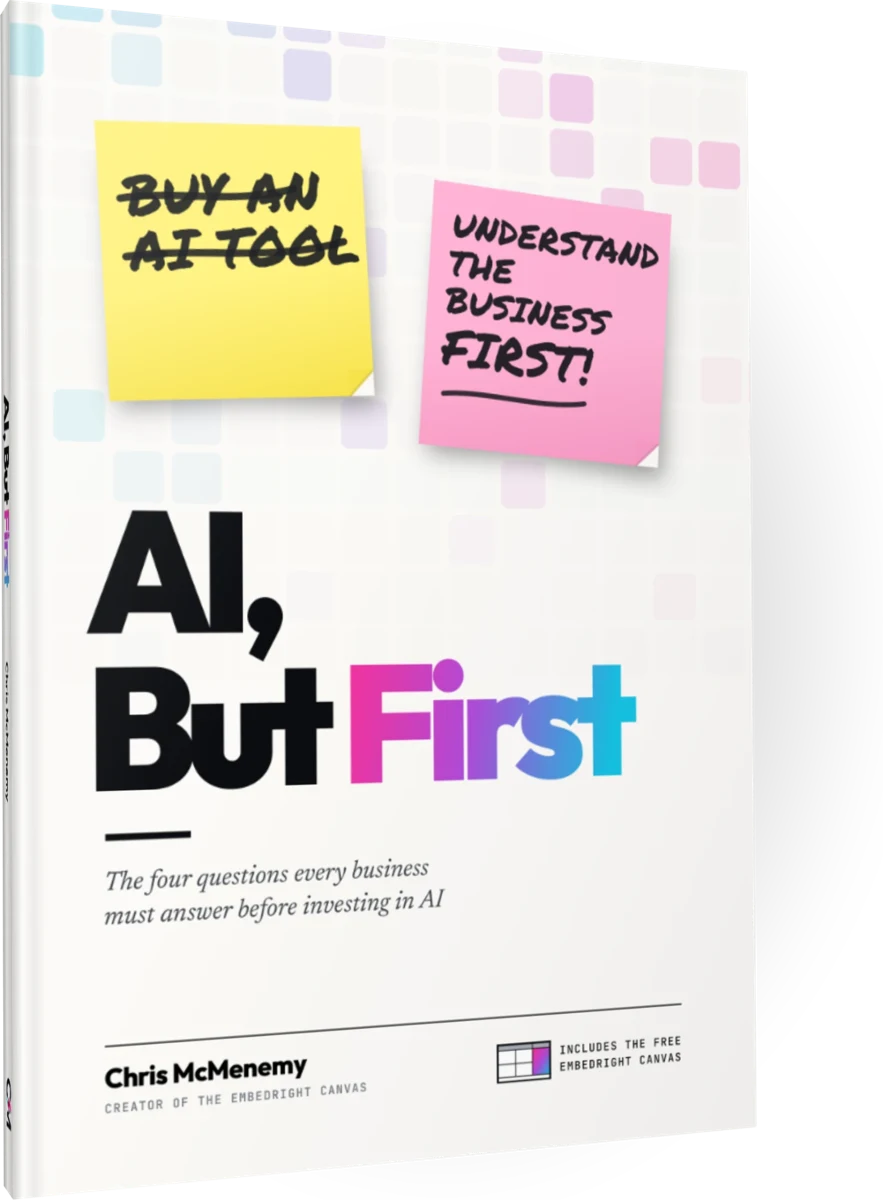
That is the whole argument of EmbedRight and it is not specific to legal. It is just unusually visible in legal, where the difference between two firms on the same street is rarely the documents.
Where to start
Not with a tool. Four questions, in this order.
- 1What are clients actually paying this firm for? Not what you bill for. What makes them instruct you rather than the firm next door.
- 2Where does the week actually go? Not the recorded time. The hour at seven in the evening that never gets recorded.
- 3Of that, what could a competent person check faster than they could do?
- 4What must stay human, because it is the answer to question one?
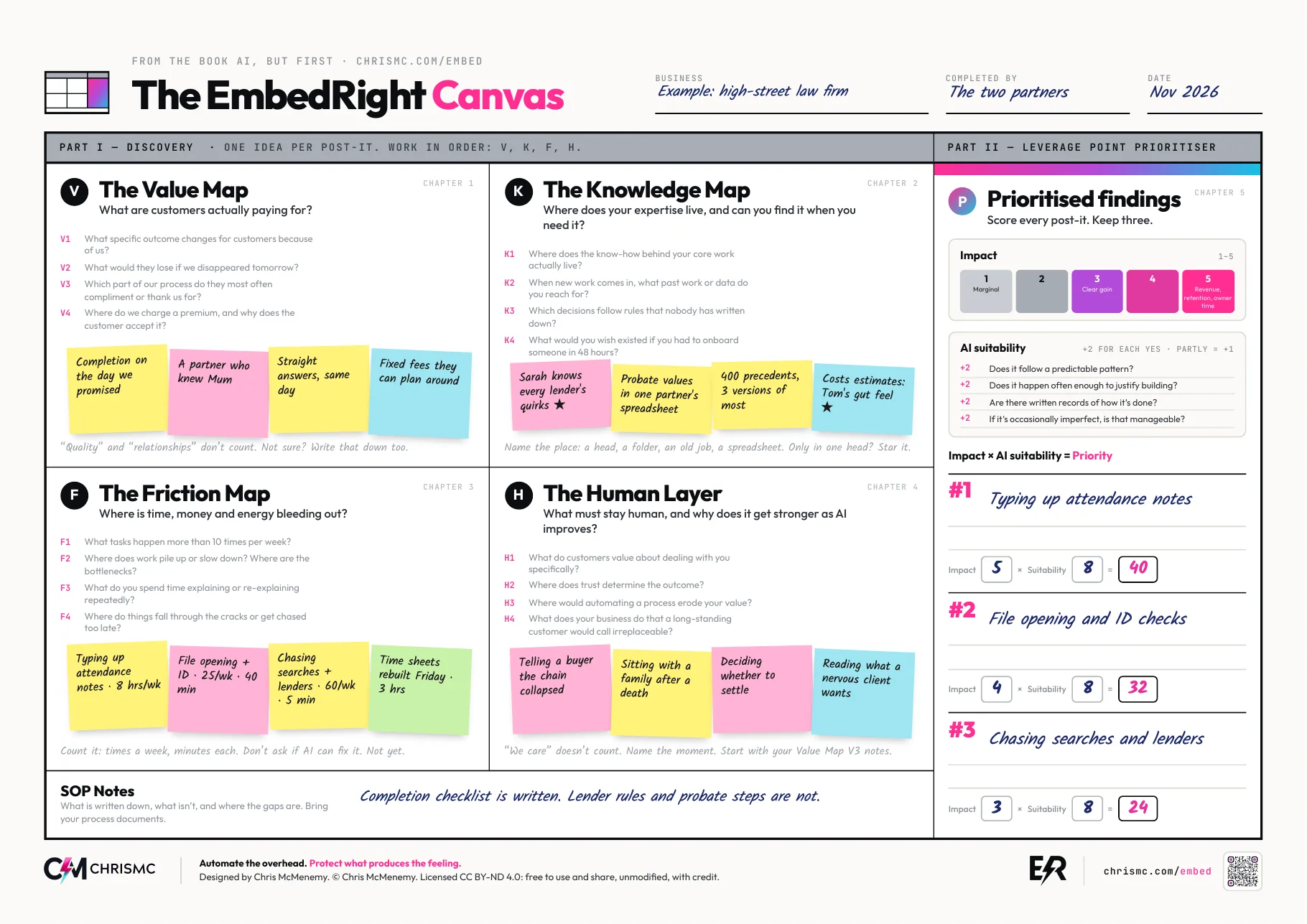
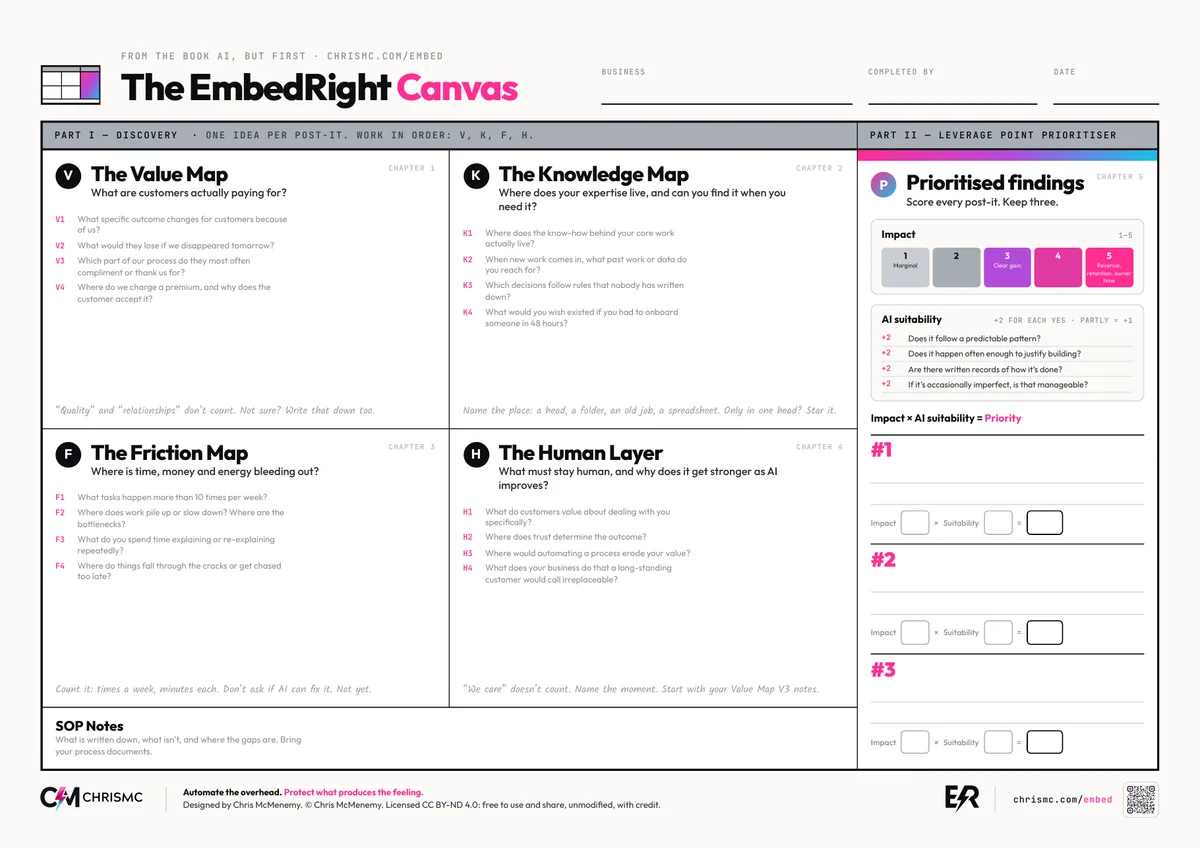
Those four questions are the first half of the EmbedRight canvas. The second half scores what you found on impact against how suitable it actually is for AI, and ranks it, so you come out with the two or three things worth doing rather than a list of forty you will never start.
Worked example
One firm's canvas, filled in
Free download
The EmbedRight canvas
It is free and it takes an afternoon.
The method in full: AI, But First ↗Questions people ask
Is our firm too small for this?
The third and fourth jobs on this list get better value at small scale, not worse, because a small firm has no back office to hide the overhead in. The first job, document review in volume, is the one that genuinely needs scale to justify the licence.
Will this replace our paralegals?
It changes what the role is before it changes how many of them you need. The parts that are reading and summarising get faster. The parts that are chasing, judging and dealing with people do not. Firms that cut first and work out the role afterwards tend to rehire.
What about client confidentiality?
Treat it as a contractual question, not a technical one. Where is the data processed, is it retained, is it used for training, and who is liable if it leaks. Get the answers in writing. A tool that cannot answer those four in writing is not a candidate.
How much should we expect to spend?
Less than you are quoted, if you start with the third or fourth job on this list. Both can usually be built on tooling the firm already pays for. The expensive category is document review in volume, and that is the one to do last unless disclosure is your main business.
We tried an AI tool and it did not stick. What went wrong?
Usually that it was bought as a tool rather than designed into a workflow, so using it stayed optional and the old way stayed available. The second most common reason is that it was pointed at the interesting work instead of the boring work.