
The short answer
Will AI replace accountants? If you mean whether the profession will exist in ten years, no: somebody has to sign the return and carry the liability. If you mean whether the people currently employed as accountants will still be employed as accountants, then for most of them the answer is also no. In the video below I score a typical 20-person firm with the same EmbedRight rubric I use on client work. Eight of the twenty roles survive. The only thing holding that arithmetic back is one partner meeting.
Chapters
- 10:00 Will AI replace accountants
- 21:11 The canvas, run on a real firm
- 33:16 Layer 1: the Value Map
- 44:00 Layer 2: the Knowledge Map
- 55:07 Layer 3: the Friction Map
- 66:28 Layer 4: the Human Layer
- 78:27 Phase 2: scoring it live
- 89:56 The arithmetic: twenty to eight
- 910:53 The pipeline problem
- 1011:40 The timeline
- 1112:14 Why this is happening now
- 1214:39 Friction Map to Threat Map
- 1315:08 Where your value is
- 1416:46 The four paths
- 1520:55 Your next 30 days
- 1622:28 The hard part
- 1723:23 Which one is yours
Will AI replace accountants, or only some of the jobs?
It replaces the jobs that are mostly made of work a machine can already do, not the profession itself. Clients of a typical firm are buying three things: a return filed on time, a tax figure they can trust, and somebody to call when something changes. Only one of those is a document.
Knowing the rules is already a reference task. Judgement lives in about five heads in a firm of 20. The time bleeds out in chasing, re-keying, reconciliation, queries, prep and formatting. In the firm I scored, that was ten of the 20 people: the eight staff accountants on production, and two of the three on admin. The Human Layer is six people, none of them also in the friction layer.
The same pattern shows up in law firms: automate the certainty the client is actually buying, and you remove the reason they were paying you.
How do you score which jobs AI reaches first?
With four questions, two points each, for a maximum of eight. Any job that scores six or more is one the software reaches first.
| Question | Points if yes |
|---|---|
| Does the work follow a predictable pattern? | 2 |
| Does it happen often enough to be worth changing? | 2 |
| Do written records show how it should be done? | 2 |
| If the output is occasionally wrong, are the consequences survivable? | 2 |
Document chasing scored eight: the same documents every quarter, perhaps 50 times a week, a checklist on file, and a wrong chase noticed before anything is filed. Reconciliation and re-keying also scored eight. Telling a client something they do not want to hear scored zero. The three highest-scoring rows were the job description of eight of the 20 people.
The only thing standing between your firm and that arithmetic is somebody in your partner meeting realising it is possible, and deciding to go ahead.
What does the arithmetic look like in a 20-person firm?
It is a halving, not a 10% efficiency story. The ten people whose week sits inside the Friction Map go. The two partners and three managers stay. You keep two of the four seniors, to review the output and hold the judgement, and one person on admin. That is eight out of 20, doing the same volume of work, or more, because the bottleneck was the prep.
Every good senior learned judgement by doing about 3,000 hours of that friction work. Take that away and, in nine years, the firm has no seniors of its own. That is a problem for the partnership, not a reason to wait if you are in the ten.
There is no date you can circle, and you do not get 18 months' notice. BambooHR's May 2026 finance analysis found US senior-to-entry hiring at 3-to-1 (BambooHR). KFF's 2026 survey of 1,937 employers put average family health cover at $28,303 a year, up 5% (KFF). The gate is a partner meeting, not a laboratory breakthrough.
If you run the firm, the next step is how to implement AI in an accountancy firm without automating the reason clients stay.
What are the four paths that survive?
"Learn AI" is not one of them. The four ThriveRight paths I walk through in the video are the Orchestrator, the Builder, the Creator and the Human. Three involve leaving.
- 1The Orchestrator. Stay and run the systems, rather than be the person they replace. Almost everybody picks this, which is the problem: two seats, and 12 people who need one. The people who get these seats had already automated a piece of their own work, six months before anybody asked, and could show the partners what it saved.
- 2The Builder. Leave and own something physical. After enough sets of financials you often know which local businesses actually make money. Equipment rental, commercial cleaning, excavation, waste hauling, pest control: work that still requires someone to turn up.
- 3The Creator. Build an audience so your income does not depend on one employer's decision. As I say in the video, a search for AI tools for accountants on YouTube often surfaces accountants with audiences, not software companies.
- 4The Human. Go where the value is that it is a person and not a model: coaching, teaching, training, examining, CPA instruction or review.
Hoping to be one of the two Orchestrator seats is the same thing as having no plan. If you do nothing, you become the person the system gets built on top of: the one asked, nicely, to document the process.
What should you do in the next 30 days?
Start the same way, whichever path you pick:
- 1For one week, write down your actual week: every task, honest hours. The sheet is for you alone, never for the firm.
- 2Score each line with the four questions above.
- 3Add up the hours that score six or more. That is the proportion of your job that is leaving.
- 4Keep the hours that score low. That is what you build on.
The gap between starting in 2026 and starting in 2029 is the difference between arriving early and arriving with everybody else.
Questions people ask
Will AI replace all accountants?
No. It replaces the work that scores six or more on the rubric. Someone still has to sign the return, carry the liability and have the conversations clients actually pay for.
Which roles in a typical firm are most exposed?
Staff production work and most of the admin and bookkeeping support. In the firm I scored, that was ten of the 20 people.
If I want to stay, how do I get one of the remaining seats?
Do not wait to be asked. Automate a piece of your own work on real client files, and show the partners what it saved.
What if I run the firm?
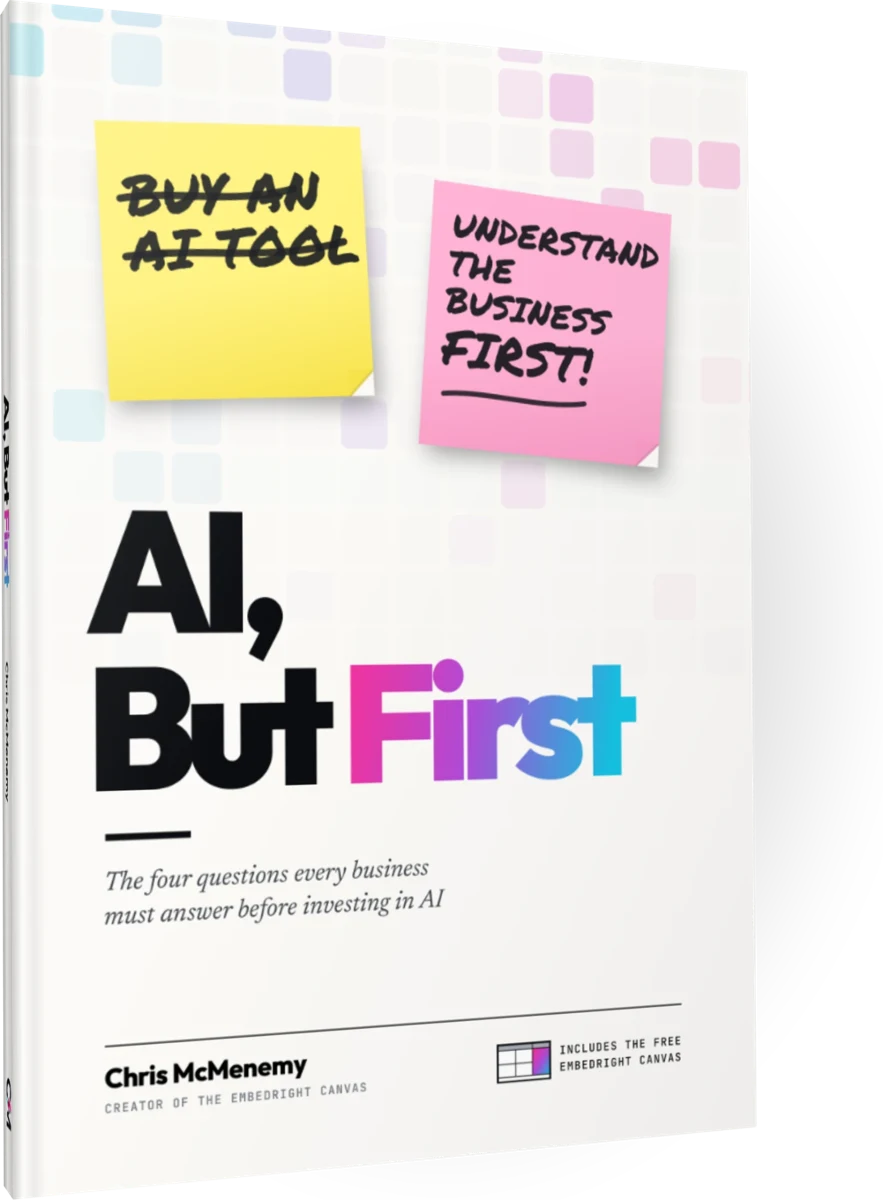
Fill in the free EmbedRight canvas honestly, then use how to implement AI in an accountancy firm to change the work without automating the advice.
Where to start
If you want your version of the second map without doing the 30 days on your own, take the ThriveRight quiz. It will tell you which of the four paths fits what you actually do all day. If you run the place, download the canvas and fill it in with the people who do the work. Either way, pick one of the four. Not next quarter. Straight away.