When your clients ask about AI
Fractional CFOs, COOs, coaches, accountants and IT firms get asked about AI all the time. EmbedRight gives your clients a proper answer: where AI belongs in their business, where it does not, and the first changes built. You stay the adviser they already trust.

Your clients are asking you about AI more and more.
It comes up after a board meeting, in a monthly review, or on the call after someone has watched a demo. They ask you because they trust your judgement.
Usually it is not what you were brought in for. You run the numbers, the operation, the plan, the accounts or the systems. AI was not in the brief, so the options tend to be a polite shrug, a vendor introduction, or evenings spent getting up to speed on something outside your practice.
None of those serves the client well. The first leaves them stuck. The second often ends with a tool nobody uses. The third costs you time, and the client still needs someone to do the work.
What most of them need is someone to sit with the people who do the work, find where AI would change something real, and then build it. That is what EmbedRight is for.
How it works for your client
Four steps. You make the introduction, the AI work gets done properly, and you remain their adviser throughout.
- 1
A short call about the client.
You tell me about the business, what they have already tried, and the question they are asking. If EmbedRight is not the right answer for them, I will say so, and you will have lost half an hour rather than a client's goodwill.
- 2
You make the introduction.
You stay in the room if you want to. You know the business, the people and the history, and that makes the work better.
- 3
The team works through the EmbedRight Canvas.
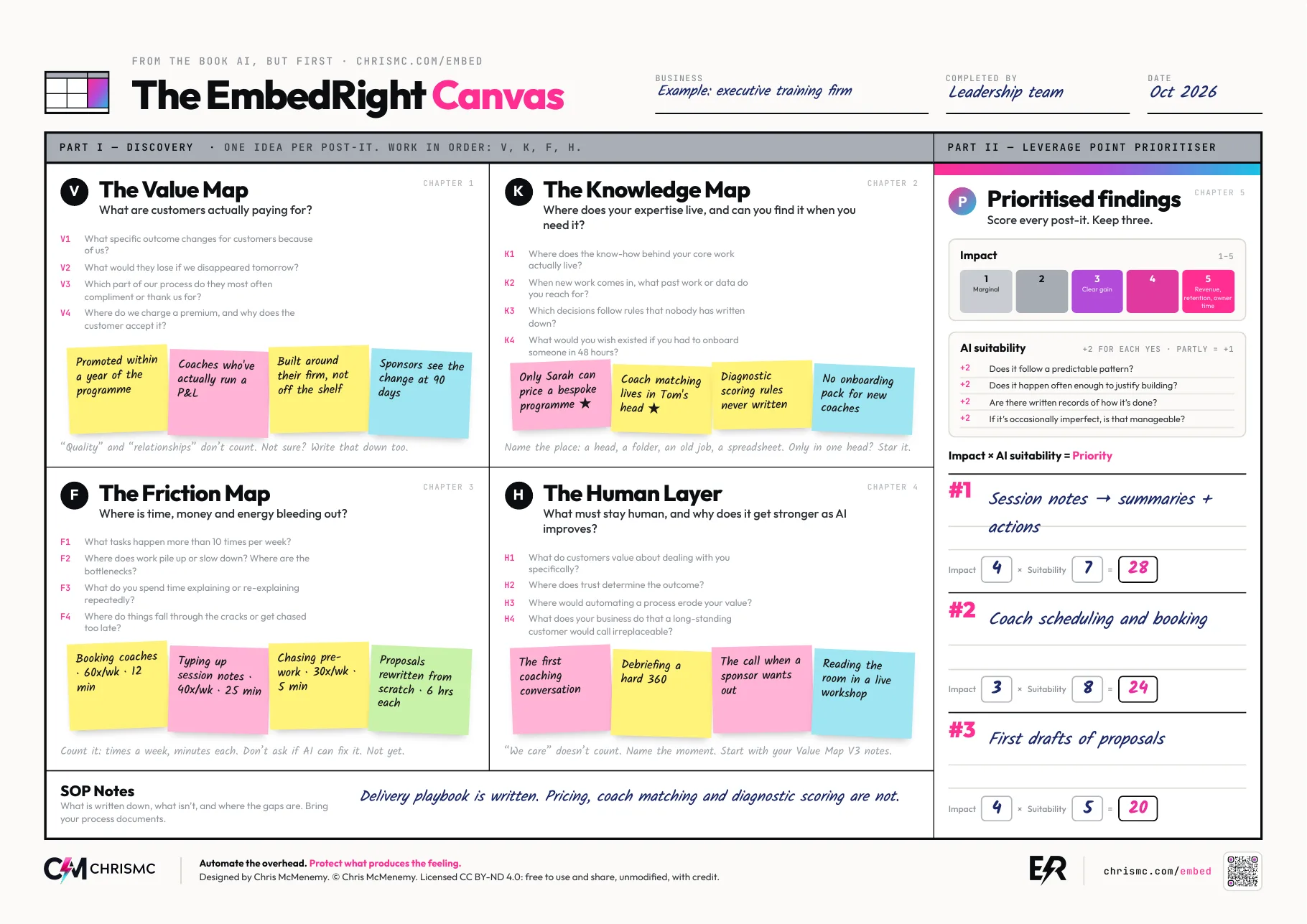
With the people who actually do the work, we map what customers are paying for, where the expertise lives, where time and money leak out every week, and what has to stay human. Every finding is scored on impact against AI suitability, so the business finishes with the few things worth doing first, not a list of forty nobody will start.
- 4
The first changes get built.
Not a report that sits in a drawer. The changes are built into the systems and workflows the business already runs, and the team knows why each one was chosen.
What your client works through.
One sheet, on a wall or a desk, worked through with the people who do the job. It is how the conversation stays on the business rather than on the software.
- Value
- What customers are actually paying for.
- Knowledge
- Where the expertise lives, and who holds the keys.
- Friction
- Where time, money and energy leak out every week.
- Human
- What has to stay human, and why that matters more as AI improves.
Every finding is then scored on impact against AI suitability, which is what turns a long list into a short plan.
What your client gets
- A clear picture of where AI belongs in their work, and where it does not.
- A ranked plan of what to automate, and what to leave alone.
- The first changes built into the systems they already run, measured in weeks, not years.
- A team that understands why those changes were chosen, so the work keeps going after the engagement ends.
Not another unused subscription, or a demo dressed up as a strategy.
What you get
- A good answer the next time a client asks about AI, without having to become an AI consultant.
- Something useful to bring to a relationship you already have.
- Your place as the trusted adviser stays exactly where it is.
- A copy of AI, But First, so you can judge the method for yourself before introducing anyone.
There is no certification to sit and nothing new to sell. When the question comes up, you have a good answer and someone to bring in.
The method behind the canvas.
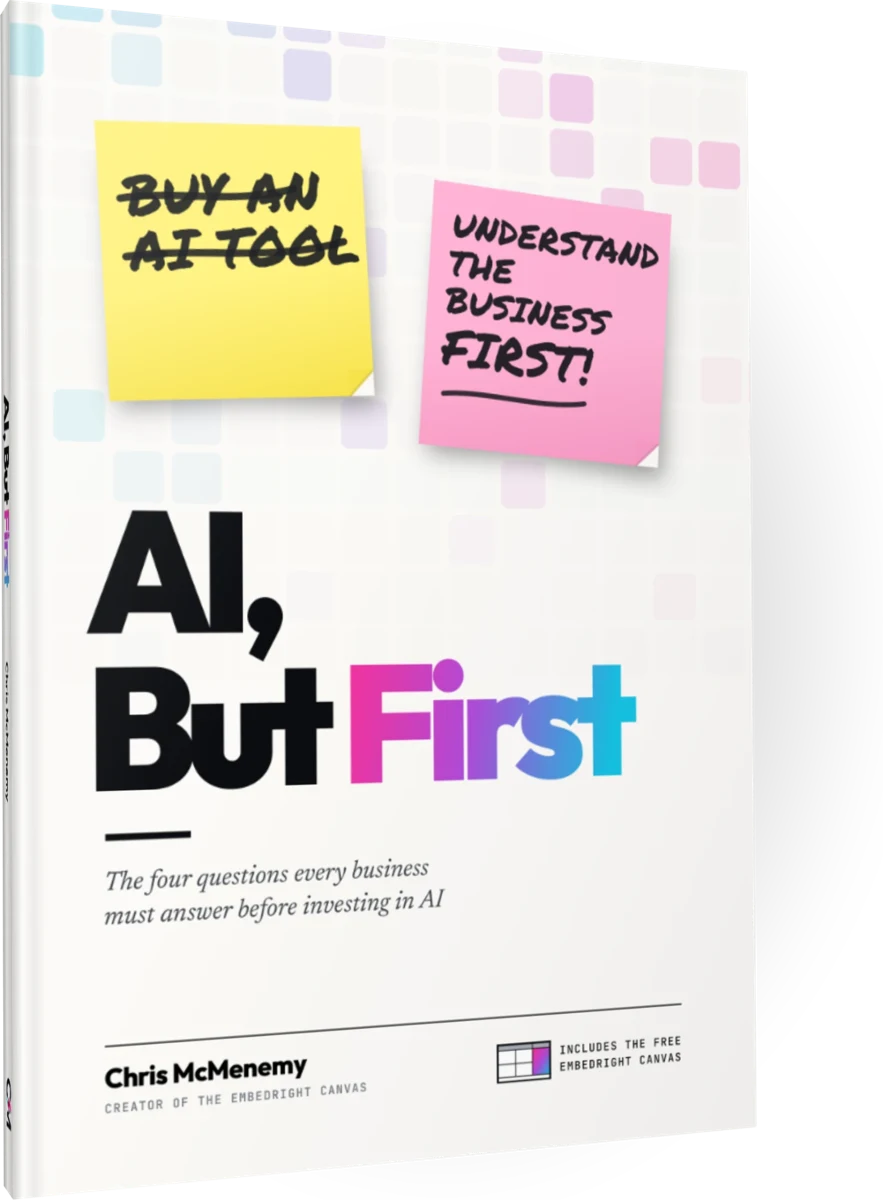
AI, But First
The four questions every business must answer before investing in AI.
Most companies buy the tool and then wonder why nothing changed. This is the part that comes first: working out which bits of a job should survive contact with the software, and which bits were never really the job.
What partners usually ask
Will this get in the way of my relationship with the client?
It should strengthen it. You make the introduction and you remain their adviser. The work is scoped to the AI question they brought to you, and nothing else.
Do I need to know much about AI?
No. Your job is the relationship and the judgement you already sell. The canvas does the structuring, and the build is handled for you.
What if they have already bought a tool?
That is often exactly when this helps. Plenty of businesses buy the software everyone else bought, and almost nothing changes. The work is finding which parts of the job should survive contact with it, then changing how the work actually moves through the business.
How long does it take, and what does it cost?
The build is designed to land in weeks, not years. Timing and fees depend on the business and on what comes out of the canvas.
When a client asks, let's talk.
If your clients have started asking about AI and you want to give them a better answer than a shrug or a vendor demo, start a conversation. A few details is all it takes, and I will send you a copy of AI, But First.
Start a conversationEvery message read personally. If EmbedRight is not right for a particular client, you will hear that straight away.

What I'm seeing from inside the machine.
The roles quietly disappearing. The businesses that are suddenly viable. What I built this week and what broke doing it. And what I'd actually do about any of it, rather than what sounds good on LinkedIn.