
The short answer
How to implement AI in an engineering firm comes down to one rule: start with the work, not the tool. Map what clients pay for, where the know-how lives, where the hours leak and what must stay human, then score impact against AI suitability and do the top three.
Why does AI so often fail to stick in engineering firms?
It fails because it is bought as a tool. A director sees a model draft a specification from a blank prompt, the firm buys seats, and six months later the job folders are still how the work is done.
The hours go on finding the last specification, copying a fee proposal and keeping the document register. The test is the one I use for law firms and for how to implement AI in an accountancy firm: a human must be able to check the output faster than they could have produced it.
I built a decarbonisation engineering business from one person to fifty-four, across Glasgow, Istanbul and Hong Kong. A few heads held the expertise. Finding, formatting and chasing took the hours.
How to implement AI in an engineering firm, step by step?
Work through the four maps of the EmbedRight canvas in order, then score:
- 1The Value Map: what are clients actually paying for? Approvals that stick, engineers who know the building, and a named person behind the answer.
- 2The Knowledge Map: where does the expertise live? Name the place. Star the person who is the only one who knows it.
- 3The Friction Map: where do the hours leak? Count times a week and minutes each. Specifications, archive search, the register, minutes, fee proposals, drawing checklists.
- 4The Human Layer: what must stay human? Design sign-off and professional liability, site judgement, and the conversation when a scheme will not work. On a safety-critical calculation a model may assist, and an engineer checks and signs.
- 5Score and rank. Impact from 1 to 5, times AI suitability from 0 to 8. Two points each for a predictable pattern, enough volume, written records of how it is done, and occasional imperfection being manageable. Keep the top three.
The client does not pay you to find last year's specification. They pay you for the engineer who will stand behind the design.
Which engineering tasks is AI actually good at?
AI fits a settled pattern, with enough volume to change and a check against work already issued.
| Task | AI suitability | Why | Where it often already lives |
|---|---|---|---|
| Spec and report drafts from your own projects | High | Checked against the last issue | Job archive and templates |
| Searching past projects and standards notes | Medium to high | In a file the firm already wrote | Project folders and notes |
| RFI, submittal and document register admin | High | Same fields weekly. A wrong row shows | Register and inbox |
| Meeting minutes and action tracking | Medium to high | Checked against the meeting | Notes and actions |
| Fee proposal first drafts | Medium | From your own past proposals | Proposal templates |
| Drawing QA checklists | Medium | Clerical rows. Engineering rows stay signed | Issue checklist |
| Design sign-off and professional liability | Low | The client buys the signature | Keep it human |
| Site judgement | Low | Someone has been to site | Keep it human |
| Client trust conversations | Low | The hard meeting is the instruction | Keep it human |
| Safety-critical calculations | Low | An engineer checks and signs | Keep it human |
What should stay human in an engineering firm?
The signature, the site and the conversation. A named engineer carries the design, and someone who has seen the building says when the drawing is wrong. A safety-critical calculation fails the test, because checking it means doing it again.
What does an illustrative engineering canvas look like?
What follows is an illustrative canvas for a 40-person building services consultancy, not a client. The same four maps, in this order, apply to civil, structural, mechanical and marine work.
Worked example
One firm's canvas, filled in
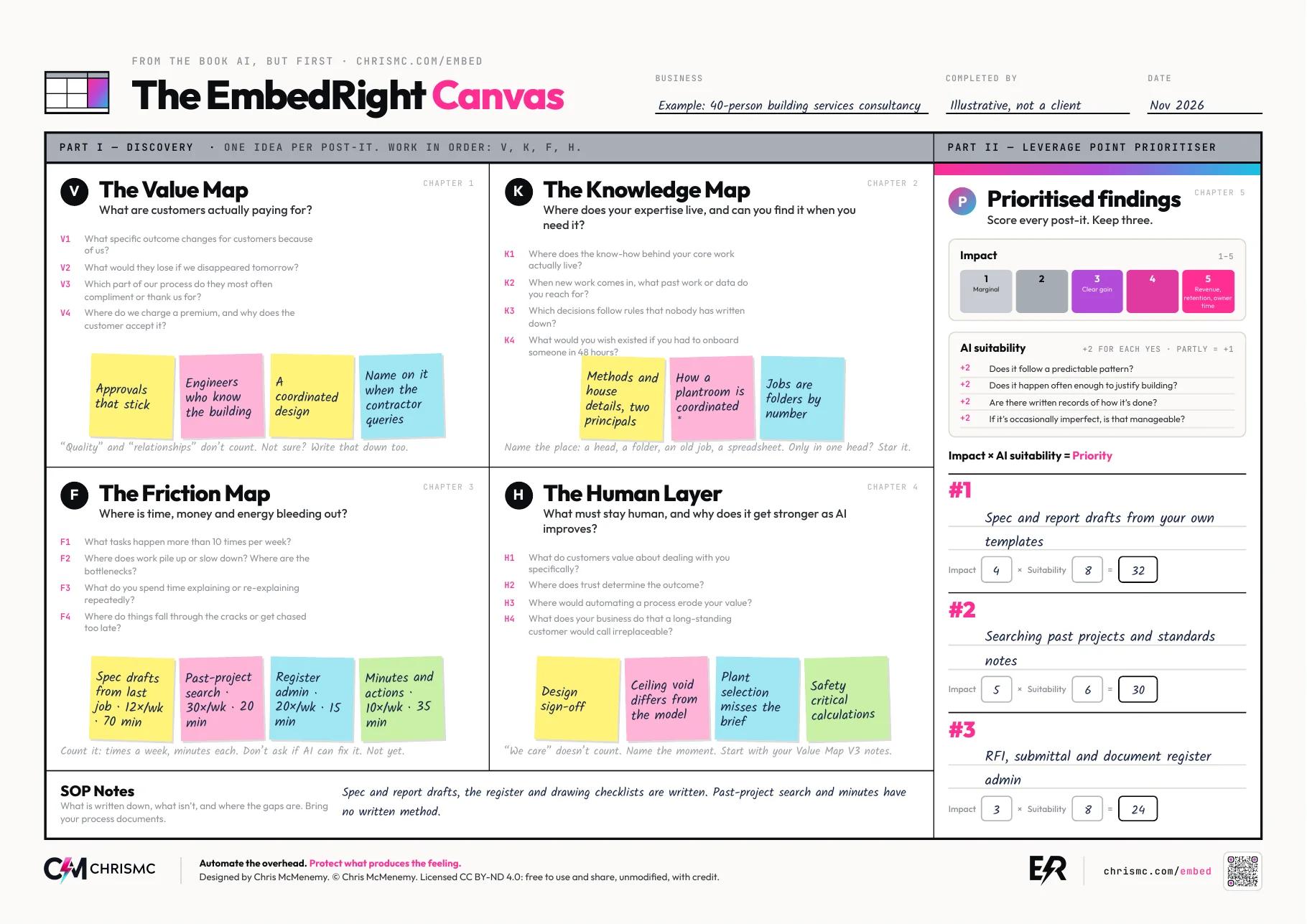
Value Map. Clients pay for a coordinated design that gets through approvals, with a name on it when the contractor queries it.
Knowledge Map. Methods and house details sit with two principals and one associate. Jobs are folders by number. Star the associate: single-head knowledge of how a plantroom is coordinated.
Friction Map. Illustrative counts. Specifications from the last job: about 12 times a week, 70 minutes each. Past projects and standards notes: about 30 a week, 20 minutes. The RFI log, submittals and the document register: about 20 a week, 15 minutes. Minutes and actions: about 10 a week, 35 minutes. Fee proposal drafts: about 4 a week, 90 minutes. Drawing-issue checklists: about 15 a week, 20 minutes.
Human Layer. Design sign-off. The visit where the ceiling void differs from the model. The meeting where a cheaper plant selection misses the brief. Safety-critical calculations. All four stay off the plan.
Spec and report drafts from your own templates: impact 4 × suitability 8 = 32, all four yes. Searching past projects and standards notes: impact 5 × suitability 6 = 30, for pattern, volume and an obvious wrong file. No written method, and the impact is 5 because the associate is a single point of failure. RFI, submittal and document register admin: impact 3 × suitability 8 = 24. The top three are 32, 30 and 24.
Minutes scored impact 3 × suitability 6 = 18, with no written method. Fee proposals scored 3 × 6 = 18, because a wrong exclusion is not a manageable miss. Drawing checklists scored impact 2 × suitability 8 = 16 on the clerical rows alone. Safety-critical calculations stay in the Human Layer.
Questions people ask
Is a firm of forty too small?
Often there is no document-control team, so the register, the minutes and the archive search sit with the people who design. Start from the folders you already keep.
Will this replace our engineers?
Production tasks move first. Someone still signs, goes to site, and holds the conversation the client is paying for.
Can we use AI on calculations?
As a first pass the signing engineer can check faster than they could have produced it. Safety-critical calculations stay human.
Is it safe to paste a live job into an AI tool?
Treat it as a professional obligation. Ask where the data is processed, whether it is kept or used for training, and who is liable, and get the answers in writing first.
Where should you start?
On your own Friction Map, with the people who write the specifications and keep the register. Download the free EmbedRight canvas and keep the top three. An EmbedRight engagement runs that canvas in your organisation, then builds the implementations. The method is in AI, But First. Get in touch.